



In jewelry manufacturing facilities, the creation of rubber molds is a highly demanding technical discipline, as the quality of the mold directly impacts the integrity of both the wax models and the raw metal castings, while also directly influencing the overall lifespan of the mold itself. Rubber molds crafted by highly skilled mold-makers exhibit virtually no deformation, cracking, or flashing after wax injection; consequently, they require minimal—if any—wax trimming or welding. This significantly reduces the labor hours required for finishing work, thereby yielding substantially higher production efficiency.
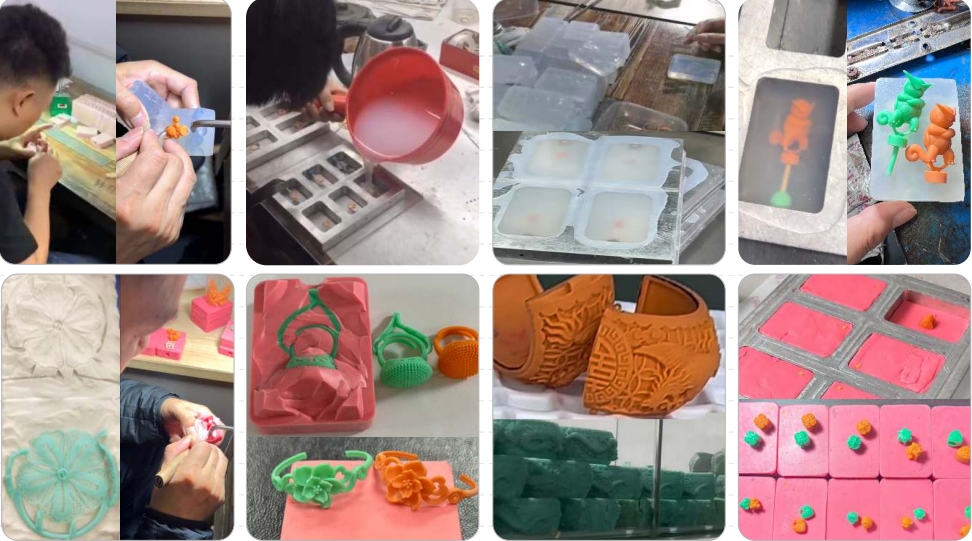
The tools required for cutting rubber molds are relatively simple, including scalpels and blades, tweezers, scissors, needle-nose pliers, and similar items. Beginners should note that when using a scalpel, it is essential to use a brand-new blade; counter-intuitively, this actually makes it *less* likely for you to cut your fingers. During the cutting process, to ensure proper lubrication between the blade and the raw rubber mold, you may dip the blade in water or detergent (however, *never* use oil, as oil will cause the rubber mold to harden and become brittle). Rubber molds typically utilize a "four-post" alignment method; this means the finished mold features four interlocking posts that serve to align and secure the two halves. The sections of the mold located between these four posts may be cut using either straight lines or curved lines.
The general procedure for cutting a mold (using a ring mold as an example) is as follows:
1. Once the pressed rubber mold has cooled to a temperature that is comfortable to handle, use scissors to trim away any excess flash (thin edges). Then, use needle-nose pliers to remove the sprue block and peel away the outer vulcanized shell.
2. Stand the rubber mold upright with the sprue facing upward. Insert the blade from one side of the sprue and cut along the centerlines of the mold's four outer edges to a depth of 3–5 mm (this depth may be adjusted as needed based on the size of the mold), thereby cutting through the four sides of the mold.
3. Cut the first alignment post, starting from the point where you made your initial incision. First, cut two straight edges to a depth of 3–5 mm (again, adjustable based on mold size). Then, firmly pull apart the two cut edges and make a diagonal cut at a 45-degree angle to form a right-angled triangular post. At this stage, the cut surfaces of the two mold halves should feature corresponding "positive" (protruding) and "negative" (recessed) triangular posts that interlock perfectly.
4. Following the procedure outlined in the previous step, proceed to cut the remaining three alignment posts in succession.
5. Pull apart the mold at the location of the first post you cut, and use the blade to make a steady, inward cut along the centerline of the mold. (If using the curved-cut method, you should instead oscillate the blade in a specific curved motion to create a "fish-scale" or wave-like cutting surface.) As you cut, continue to gently pull the two halves of the mold apart. Exercise extreme caution as you approach the sprue line; use the tip of the blade to gently pry open the mold and expose the sprue channel. Finally, cut through the ring band along one of its outer end faces, continuing the cut until you reach the decorative head (setting) of the ring.
6. Cutting around the decorative head—this is typically the most difficult and complex step in the entire mold-cutting process. If the setting for the main stone utilizes a prong setting, the section containing the decorative head should be cut along the axis of two adjacent prongs on one side. Continue cutting toward the outer rim of the ring on the opposite side of the head, stopping once the cut reaches the sprue location. At this point, the rubber mold will have been split into two halves; however, the silver master model cannot yet be removed.
7. Cutting the section of the rubber mold containing the settings and the decorative head: In the spaces between the main stone setting and the settings for the side stones, extend the cuts previously made along the axes of the two outer prongs of the main stone setting, continuing until you reach the two corresponding prongs on the opposite side. Next, make a cut along the remaining outer edge of the main stone setting—perpendicular to the previous cuts—until it intersects with the existing cut surfaces; this ensures the main stone setting stands upright within the mold. Finally, make a horizontal cut across the base of the prongs for both the main stone and the side stones, thereby separating the decorative head section into two distinct parts. Gently pull apart the cut sections and inspect them carefully for any stretched strands of rubber (typically formed within the holes of the side stone settings or the openwork sections of the decorative head); if any are present, they must be severed.
8. Remove the silver master model. As you do so, carefully check for any remaining strands of rubber adhering between the silver model and the mold; if any are found, cut them away.
9. Cutting the base: Make a deep, continuous cut along the entire circumference of the ring's inner band. The cut should extend close to the bottom surface of the mold but must not cut all the way through. Flip the rubber mold over, grasp the sides with your fingers, and flex the mold open along the line of the cut. You should now be able to observe the circular cut along the inner band, as well as the cut lines corresponding to the settings and the decorative head (since these cuts did not go all the way through, the remaining stretched rubber will have formed slightly recessed, shallow grooves). Follow these grooves with your cutting tool until you reach the corresponding sprue location. Next, make a cut parallel to the sprue to create a strip approximately 8–12 mm wide, extending nearly to the base of the sprue. At this stage, the base of the mold will have taken on a mushroom-like shape, allowing you to pull the inner section of the ring out through the opened base. Only when the mold has been cut in this manner can the wax model be successfully extracted later.
The completed rubber mold should undergo a thorough final inspection. Ensure that the interior of the mold is free of any defects—such as obvious tears in the decorative details, chipped corners, or unwanted adhesions—as these could lead to defects in the resulting wax models. Any such flaws must be repaired; for instance, by completing any cuts that were left unfinished, or by using a wax welder to patch up torn decorative elements or chipped corners. Furthermore, for original models with complex structures, the cutting surfaces should be adjusted according to the specific circumstances. For instance, multi-layered bezel-set jewelry should be cut layer by layer—sometimes even requiring a nested cut to extract an inner core—while multi-layered pendants or large, intricate medallions may not require a base cut, allowing for direct layer-by-layer separation instead. Rubber molds should be stored in a cool, dark environment, protected from exposure to oils and acidic substances. If used infrequently, a rubber mold can remain serviceable for over a decade. However, with frequent use, molds are typically retired after about two years; by this time, repeated exposure to heat during wax injection causes the rubber to harden, significantly diminishing its performance. When factoring in the need to accommodate evolving design trends, the practical service life of a rubber mold generally falls within a range of two to three years.
TAG: